Magazine of the painting blogosphere.

Submit a Blog or Link

Email Sign Up
Painting Posts of the Week via Email

Painters' Table Blog

Robert Goodnough: Subject Matter of the Artist

Subject Matter of the Artist: Robert Goodnough, 1950-1965
Edited with an Introduction by Helen A. Harrison, Foreward by Irving Sandler, Soberscove Press


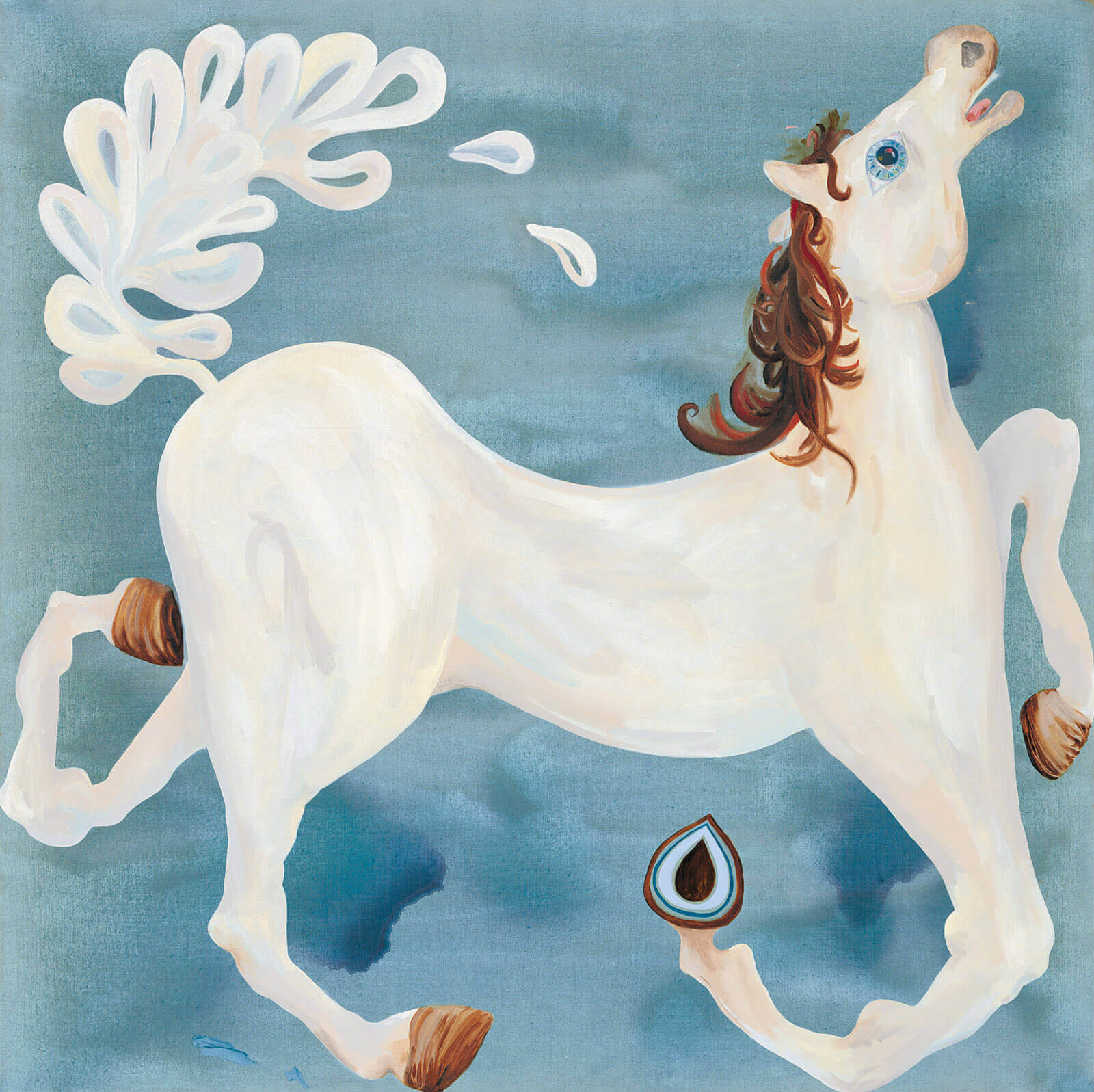
Cover featuring Robert Goodnough, Horses III, 1960, Collection of Milette and Haag Sherman, Houston, Texas, courtesy of Langs De Wal Gallery, New York © Estate of Robert Goodnough

Subject Matter of the Artist: Robert Goodnough, 1950-1965, a new book published by Soberscove Press, is a time capsule of sorts. It unearths a lost primary source, penned by a significant artist, one that sheds first-person light on some of the most iconic artists of the New York School. It also conveys, through the enthusiasm of its author, a palpable sense of the excitement of a painter consciously aware he is in the midst of a significant avant garde moment.

Irving Sandler, in the foreward, describes the ethos of this moment (1949-1950) and its influence on Goodnough. It was a “lively avant-garde ferment,” Sandler writes, “in which [Goodnough] was introduced to the latest and most vital art and ideas, and all the fresh options in contemporary art.” (p.9)

As a graduate student and protege of Tony Smith at NYU, Goodnough embraced these ideas. He sought out avant garde painters, not only making the acquaintance of key artists of the New York School, but also visiting their studios and interviewing them for a research paper. This important, nearly unknown piece of writing, titled Subject Matter of the Artist: An Analysis of Contemporary Subject Matter in Painting as Derived from Interviews with those Artists Referred to as the Intrasubjectivists, is the centerpiece of this new collection.

Goodnough is known primarily as a second generation Abstract Expressionist, the generation that included Joan Mitchell, Grace Hartigan, Sam Francis, and Norman Bluhm among others. He also penned the seminal ArtNews article, “Pollock Paints a Picture,” a first hand account of Jackson Pollock’s novel drip painting technique (also included in this new volume - along with an interesting new revelation about that text).

Pollock, we learn, was not the only important painter observed and interviewed by Goodnough. In Subject Matter of the Artist, he turns interviews with key icons of the New York School, including William Baziotes, Mark Rothko, Robert Motherwell, Barnett Newman, Adolph Gottlieb, and Willem de Kooning, into succinct, individual prose portraits. Historical and technical anecdotes from these portraits flesh out our understanding of these artists at the very moment they are making their mark on the history of painting.

In one interview, Rothko admits an initial aversion to visual art and discusses his relatively new effort to “eliminate any distracting awareness of paint by applying his colors without texture.” (p.47) In another, Goodnough offers a summary of Newman’s observation that “the act of painting and the bringing into existence of an art object are one and the same process. In music, a diagram is first created, then it is played on an instrument. The painter plays his instrument while he is creating it.” (p.53)

The interviews reveal shared ideas among these artists, yet opposing views also emerge, supporting the notion that the New York School was not as much a shared vision of a school of like-minded artists as an ethos arrived at through a variety of artistic motivations. Gottlieb, for instance, tells Goodnough that painting is “not only a matter of colors and shapes on canvas, but images made visible and integrated” (p.58) while Baziotes gives a contradictory statement, remarking that “reference to existing objects is not particularly helpful in contemporary painting.” (p.44)

It is this issue of subject matter, “an understanding of what is involved in approaching painting with no reference to existing objects” (p.42) that is Goodnough’s focus. His thesis resurrects for a 21st century audience the term “intrasubjectivism,” introduced in 1949 by José Ortega y Gasset to describe a non-objective painting approach. (p.42)

This approach, editor Helen A. Harrison explains, “lies at the core of what was then being defined as the new American painting, although many artists would replace ideas with even more subjective stimuli such as experiences and emotions. The artist was liberated from representation, but also unmoored from it.” (p.17)

It is clear the intrasubjectivism Goodnough explored as a writer informed his painting as well. Though he painted more and less overt subject matter throughout his career, he always seemed to privilege an improvisatory approach. As Goodnough recalls in a 1958 statement that concludes the current volume:

“the domination of the object to be looked at, always saying that a certain line should go in this direction or that, a red had to be here and a blue there because that was the way it was on the model, began to be limiting...” (p.75) Goodnough never accepted limits in his painting, embracing in his own work what he describes as the “feeling in the best work of American painters of the ‘wild’ which has been the heritage of this country.” (p.76)

Goodnough’s writing, newly presented in this book, allows the reader to feel the the excitement of being part of a small group of New York artists discovering and exploring entirely new territory in painting. To read his account is to be there the moment (characterized by Harrison) that American “wildness” succeeded French “finish,” as New York replaced Paris as the center of the art world.

Subject Matter of the Artist: Robert Goodnough, 1950-1965Edited with an Introduction by Helen A. Harrison, Foreward by Irving Sandler, will be available from Soberscove Press May 15, 2013.

SHIFTER and Soberscove Press will hold a joint book launch, celebrated through a series of short artist presentations entitled Proposals for an Impractical Education. Speakers include: Corin Hewitt, Riley Duncan, Valerio Rocco Orlando, Adelita Husni Bey, Abdullah Awad, Tyler Coburn, Jesal Kapadia, Brian McCarthy, Malene Dam, A.K. Burns and Steven Lam.

The event will take place May 11, 2013 from 5-7pm at Parsons, 25 East 13th Street, 5th Floor (NYC).

Al Held's Visual Thresholds


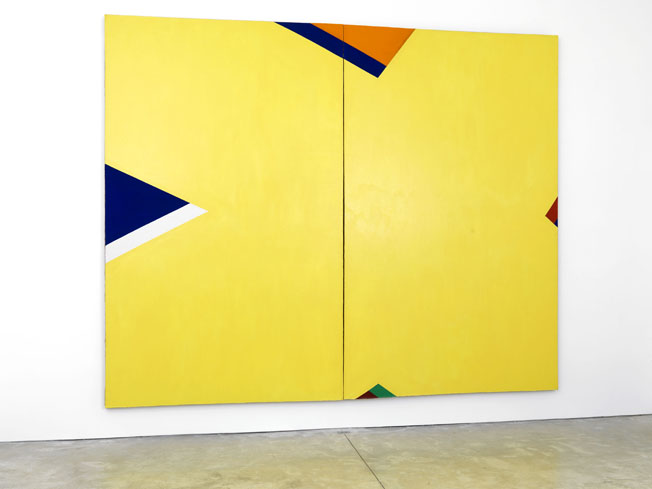
Al Held, The Yellow X, 1965, acrylic on canvas, 90 x 144 inches: Installation View, Al Held: Alphabet Paintings at Cheim & Read, New York (image courtesy of Cheim & Read)

Al Held: Alphabet Paintings is on view at Cheim & Read, New York through April 20, 2013.

Al Held's paintings of the early to mid 60s are now on view at Cheim & Read.  In them, he abandons the physical monumentality previously achieved through the accretion of heavy layers of oil paint in favor of a more visual, graphic monumentality.  This graphic monumentality comes from vigorously painted architectonic arrangements of letterforms painted on near-mural scale canvases.

Held denied a metaphorical interest in the letters; nevertheless, the pictorial device of singling out initials for monumental treatment has precedent, most notably in Celtic illuminated manuscript painting, where the scale and lavish decoration of the initial letter alert the reader to the import of the text that follows. Through their intricate design, these "initials" require concentration and pull the reader into a meditative state. They also function as visual thresholds opening outward and inviting the reader to consider the sacred worlds beyond the boundaries of the page and of earth, itself.

In much Abstract Expressionist painting of the 50s, notably paintings by Rothko and Newman, expanded abstract visual fields reflect the viewer's gaze, conjuring an awareness of self. John Yau, however, recently noted that the forms in Held's early 60s paintings, such as The Yellow X, extend beyond the picture plane, creating an awareness of the environment beyond the canvas edge. "Extending off the painting’s physical edges," Yau writes, "the X is simultaneously skewed and stable, conveying a space that hints at a realm beyond and behind the picture plane."

Making paintings that pointed outward, thresholds onto the physical world, was a stated interest of Held's. He accomplished this through drawing, as described by Yau, and also through color. Held himself noted, in a 1975 interview with Paul Cummings, that he was interested in "'taxicab' colors, loud, crass" - the colors of the city.  

More of Held's and Cummings' discussion of the "Alphabet" paintings is below:

Excerpt from: Oral history interview with Al Held, 1975 Nov. 19-1976 Jan. 8, Archives of American Art, Smithsonian Institution

Al Held (AH): "I was very much against that whole "flatness", the whole Greenberg thing of flatness and wanted to break the picture surface... There has been a constant theme there of wanting to advance that space, wanting that space I always rejected that whole notion of the picture surface as being crucial. But I would spend lots and lots of time on one edge, for instance. But the only way one could do that would be to invent a subject that wasn't simply an abstract theme. A specific subject that this thing --

Paul Cummings (PC): How do you differentiate between subject and theme?

AH: Well, now I'm using the words loosely. I just simply meant by that, thematically, stylewise the circle and the square, that the subject be specific, that it really have a very, very specific relationship. It wasn't an example of a notion or an idea; that is, it took on its own meaning, it had its own concreteness.

PC: Was that what the letters of the alphabet meant, you know, the "A" or the "I" or whatever it was?

AH: Right. They were geometric; they had the advantage of being geometric and clear. I wanted that clarity. But they also had the advantage of having -- it wasn't the literally presence, it wasn't the literal meaning that it took on a configuration that was acceptable. That's not the proper way to say it. . . You could relate to it as a form. The "A" --

PC: You mean the history one has of looking at the letter "A" in printed and various ways?

AH: No, it wasn't literal in the sense that I wasn't interested in the history of the letter "A" and how it moved from one thing to another. I was more interested in simply using it as a generalized abstract image that then I could make very, very specific. But it wasn't an eccentric form. What I mean by "acceptable" is that you didn't have to wonder what that was.

PC: So you didn't use the Cyrillic alphabet, for example.

AH: Right.

PC: You could see it was a "D" or an "I" or an "A".

AH: Right. But then beyond that you can grasp the configuration. But then I had no desire to have any kind of real literal subject. Somebody once asked me whether I used all those letters because they are the letters in my name in a kind of egocentric. . . And thinking back on it, I have used an "A", I've used an "L", I've used an "H" and an "E". I've used all the letters in my name.

PC: A "D".

AH: But it was not a conscious thing at all. I have used "X"'s too. But the point I'm making is that they were used for formal devices to make something very concrete, they weren't used for literal purposes.

PC: Now one of the other things about those large paintings is that the colors changed enormously from the early ones.

AH: Right.

PC: Was that because of the colors available in the Liquitex?

AH: That. And also the reaction to that show and also wanting the "taxicab" colors, loud, crass. And also in those days there was a great deal of talk between myself and George Sugarman about contrast of forms, of lots of contradictory forms, a multiplicity of forms. It's like this painting here, it's got a geometric shape there in red and it's got the I-Beam and it's got the yellow stripe and it's got a wave. It's got a juxtaposition of different elements in the same painting and the semantics of that kind of using disparaging forms. But that evolved out of that very quickly in the sense that I remember saying to myself: well, if I can paint a crowd _______ can't I paint one person. You know, that kind of thing.

PC: Thinking of the painting in that vein, did you have a hard time keeping it together when it was evolving? By that I mean would, say, the wavy section jump out or pull back?

AH: That's what all the struggle was with all the colors and the drawing, to keep that thing together, under tension in the relationship. They weren't simply signs or symbols placed there like --

PC: The surrealists --

AH: Right. There had to be some kind of structure to pull them all together. That's why all the time was spent on finding the right color weight. That's what all those color wights are really all about, keeping things together, keeping the relationships together, keep it under tension so it wouldn't jump out and become a whole bunch of potpourri. But there were lots and lots of notions like that. It's hard to remember all the ideas you were so excited by because they're sort of like left behind. But they're not really left behind, they're sort of like part of an iceberg but only the things you're concerned with now. Those things I've already absorbed and they're part of me. And I've left them. I sometimes theorize that what an artist really talks about are the thing he's can't do.

Trent Miller: Interview

Click photos to enlarge: 

I first met Trent Miller when he was my seat-mate on a plane traveling to Madrid in 2003. A group of painters, all Boston University MFA painters and alumni, were planning to spend a week perusing the Prado, Reina Sofía, the Thyssen-Bornemisza collection, and the surrounding towns. During the course of the flight and the following week, Miller and I discussed common interests from poetry and the films of Tarkovsky to the great Spanish painters: Goya, Velasquez, El Greco, and Picasso. We have kept in touch sporadically over the last decade, a period in which Miller has continued to develop his highly-complex and personal vision through paintings and drawings in which the observed world and that of the imagination harmoniously coexist.

Miller’s paintings render the abstraction/observation divide irrelevant as one becomes convinced, looking at his paintings, the artist does not distinguish between the two. The two modes are equivalent, and the viewer may wander between them at will.

Miller recently agreed to share his thoughts on the last decade of painting and his new work, now on view in the exhibtion Trent Miller: Spindrift and Tether on view at James Watrous Gallery, Madison, Wisconsin through February 24, 2013.

Trent Miller, Studio View, 2012 (courtesy of the artist)Trent Miller, Studio View, 2012 (courtesy of the artist)

Trent Miller, Transmitter I, oil on canvas, 45 x 36 inches, 2011 (courtesy of the artist)

PT: Many of the structures in your recent paintings feel specific, as if you were painting particular structures, rather than variations on a theme. The painted forms even feel like they inhabit specific spaces in specific locations. Do you paint from a real model, from your imagination, or do the structures in your paintings come out of the painting process?

TM: All of these paintings are coming from my imagination. I’ve been using this same tent/birdcage/scaffolding type structure for the past three years, and it continues to crop up during the painting process. The more I paint it, the more I see it around me in anything from birdcages to grain silos. I usually start with a field of color and then build layer after layer alternating between lines and larger areas of color. Over time, a particular structure with its own personality starts to take shape. I feel like each evolves into a very particular structure in a specific location, but the spaces and locations are completely imagined. This is what fascinates me: the ability to create an entirely new world in paint that references the world in which we live but in the end only exists on these canvases.

PT: Your drawings are often overtly figurative yet your recent paintings, however strong the implied figuration, are resolutely abstract. Can you talk a little about how your drawing and painting practices interrelate?

Trent Miller, THEY Offered US Fish, charcoal on paper, 14 x 11 inches, 2012 (courtesy of the artist)

TM: I’ve been making these strange little (14”x11”) charcoal on paper drawings for the past fourteen years. For much of this time, they have been very representational—with figures, interiors and exteriors—although they have moved more toward complete abstraction at times. I always joke that when I draw, I’m like a guy in a cave with a stick. I just sit down and see what emerges on the page. The drawings tend to be more intimate than the paintings, with mysterious little narratives. Painting for me is a different thing: it’s a much slower process and maybe more like making a feature-length movie as opposed to taking a photo. In recent years, this longer process has continued to point me toward these resolutely abstract images. I’ve tried to force the drawings and paintings into each other, but this is always a mistake. Interestingly, the more I let go of trying to make them relate, the more they start to inform each other. The drawings start to have bits of abstract shapes and lines in them, and the paintings start to have more landscapes and nods to the figures in them. When you see them all together in a show, really interesting relationships start to emerge.

PT: Do you draw from paintings, or vice versa? 

Trent Miller, THEY Moved the Healing Machine, charcoal on paper, 11 x 14 inches, 2012 (courtesy of the artist)

TM: I occasionally do tiny pen sketchbook drawings from paintings, but I don’t really do charcoal drawings from the paintings. I’ll also sometimes directly reference a charcoal drawing as I’m working on a painting, but it’s pretty rare. However, many of the images for the paintings and charcoal drawings start as tiny doodles on scraps of paper. I do a lot of these during meetings, while on the phone, or during other tasks when I can’t really think about what I’m drawing. It’s amazing what appears when you let your mind and hand wander in different directions.

PT: In a recent statement you declare a metaphorical solidarity with the self-taught artist Emery Blagdon, who made sculptures he called “Healing Machines.”

TM: I first saw Emery Blagdon’s work in a show at the John Michael Kohler Arts Center in Sheboygan, Wisconsin in 2008, and the experience was life-changing. When I walked into the room that contained everything Blagdon had ever made, it felt like a wave of energy hit me. The more I looked, the more transfixed I became. I walked out of that room in a bit of a daze, overwhelmed and thrilled by the mystery of Blagdon and the Healing Machine. I love the term “healing machine,” and I love the somewhat shamanistic idea of the power of the object for healing. (Note: Emery Blagdon: The Healing Machine is on view at the John Michael Kohler Arts Center through January 2014.)

Trent Miller, Drifters and Dredgers, oil on canvas, 72 x 60, 2011 (courtesy of the artist)

PT: There is a deep feeling of narrative in your work and yet a narrative never explicitly emerges. Interestingly, hundreds of narratives seem possible in any one of your paintings, from your earlier studio view paintings, like Novgorod Moon (2006) to more recent works such as Another New World (2011) and Dredgers and Drifters (2011).

TM: I love that there seem to be hundreds of narratives possible. I think It all boils down to the idea of mystery. I love the mystery of certain paintings, of certain movies, of certain songs. It’s the mystery that keeps it interesting to me. I’m not talking about work that is overly obtuse, rather work that feels like you can almost figure out the story, but something still feels a little off. The deeper you dig, the more questions you have. I’m drawn to pieces that have a particular mood but a very open-ended narrative. This is the kind of work that sticks in my head for years, and this is the kind of work that I hope to make.

PT: In 2011 you had an exhibition titled “Ten Years of Painting,” referring to the decade that had past since you came out of graduate school. Can you talk about this time a bit? In hindsight was it valuable to reflect on this period? Do you feel differently about your work moving into the next decade?

Trent Miller, Grey to Green, oil on canvas, 60 x 45 inches, 2005 (courtesy of the artist)

TM: Since finishing grad school in Boston, I’ve lived in Tivoli and Hudson, NY and now Madison, WI. Each geographic move shifted the work in a new direction. Some of this is the strain of the actual move and the settling back into a new studio and life. I’ve been in Madison for seven years now, and I’ve had my current studio in my backyard for five years.

I’m really glad I did the Ten Year show. In doing this, one of the biggest surprises for me was to find that things had actually changed less than I thought. I felt like some of the work was so different, but once it was all up I was pleased to see the similarities between the earlier studio view paintings and the more recent abstract paintings. The markmaking, the paint handling, the shapes were consistent throughout all the work. I was happy with how well some of the older work held up. It was also a nice way to draw a line and say “OK, I did that. Now what?”

Looking at the future is always a little strange because as soon as you set a course, something else pops up to send you in a new direction. I do really feel like the paintings are in control, and will give me new directions if I look hard enough. I see this new world of healing machines, water, and THEY as something that I can explore for many years.

Installation View, Trent Miller: Spindrift and Tether at James Watrous Gallery, Installation View, Trent Miller: Spindrift and Tether at James Watrous Gallery, Madison, WI (courtesy of the artist)

Trent Miller: Spindrift and Tether is on view at James Watrous Gallery, Madison, Wisconsin through February 24, 2013.

Jay DeFeo: Chancing the Ridiculous

Jay DeFeo: A Retrospective is on view at the San Francisco Museum of Modern Art through February 3, 2013. It will be on view at the Whitney Museum of American Art from February 28 - June 2, 2013.


Jay DeFeo, The Rose, 1958-66; oil with wood and mica on canvas; Whitney Museum of American Art, New York; gift of The Jay DeFeo Trust, Berkeley, CA, and purchase with funds from the Contemporary Painting and Sculpture Committee and the Judith Rothschild Foundation; © 2012 The Jay DeFeo Trust / Artists Rights Society (ARS), New York

Jay DeFeo's reputation as an imporatant painter was established before the eight year period (1958-1966) in which she poured her entire vision and energy into a single work -The Rose. Perhaps the most mythic of the great Abstract Expressionist paintings, The Rose rivals masterworks by Pollock, Still, or Rothko. In 1959 DeFeo refused the invitation to exhibit The Rose in Dorothy Miller's 16 Americans exhibition at the Museum of Modern Art, choosing instead to work on the painting for seven more years.

DeFeo remarked at the time:

"Only by chancing the ridiculous, can I hope for the sublime." 1

In 2003, curator Marla Prather succinctly captured the scope of DeFeo’s commitment to the work:

“[DeFeo] was twenty-nine years old when she began the painting, turned thirty-seven the year she completed it, and reached forty before she began making art again... After 1974, then the painting was encased in plaster, she never saw the work again...” 2

The two videos below are part of the Voices and Images of California Art series produced by the San Francisco Museum of Modern Art. In the first video, Bruce Conner discusses the development of The Rose. Conner famously documented the removal of the painting from DeFeo's apartment in his 1967 film The White Rose.

If the video does not appear please refresh the page or click here.

The Rose, is a near perfect union of image and physicality. Ironically, the overwhelming physical nature of the painting caused it to vanish. The work languished in storage for decades, until The Whitney Museum rescued, restored, and exhibited the work in 2003. The second video discusses the eventual rescue and conservation of 2300 pound painting.

If the video does not appear please refresh the page or click here.

More audio and video about Jay DeFeo and The Rose are available in an interactive feature on the SFMOMA website. Extensive information about the artist is available at http://www.jaydefeo.org

Notes

1 Jay DeFeo, 1959 statement in Sixteen Americans exhibition catalogue, Museum of Modern Art: quoted in Jay DeFeo and The Rose, University of California Press, Whitney Museum of American Art, 2003, p 42.

2 Marla Prather, Beside The Rose, DeFeo's Work at the Whitney Museum, Jay DeFeo and The Rose, University of California Press, Whitney Museum of American Art, 2003, p ix.